How to Succeed in PHYS 503 Electricity & Magnetism Exams
PHYS 503 – Electricity & Magnetism is a graduate-level Physics course at the University of Michigan-Dearborn that focuses on electrostatics, magnetostatics, electrodynamics, and Maxwell's equations. The official course details are available at the University of Michigan-Dearborn course catalog. PHYS 503 exams require students to solve complex electromagnetic problems using advanced mathematical techniques, vector calculus, and multi-step derivations rather than relying on memorized formulas. Assessments commonly include boundary-value problems, field analysis, and applications of Maxwell's equations that demand both conceptual understanding and precise calculations. As exam deadlines approach, some students search online for terms like "take my physics exam" or look for an experienced online exam taker to manage the pressure of challenging graduate assessments. For students seeking structured preparation, our PHYS 503 Electricity & Magnetism Exam Help page offers course-focused guidance, topic-wise revision, and practice strategies for quizzes, midterms, and final examinations.
PHYS 503 Exam Topics Students Must Prepare Carefully
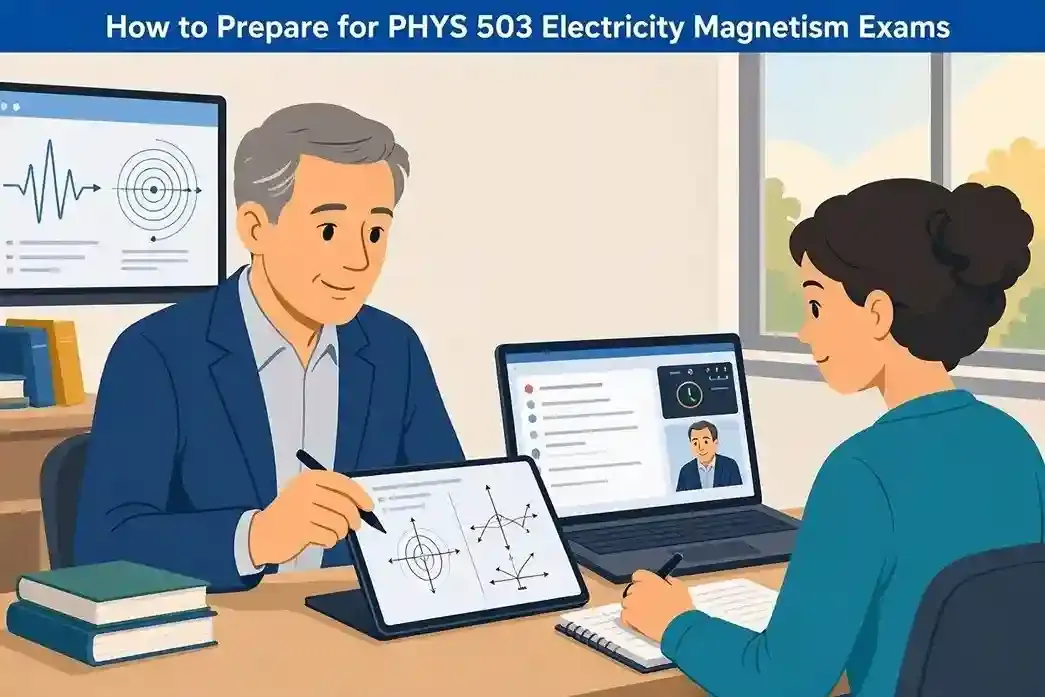
The PHYS 503 syllabus builds a complete understanding of classical electromagnetism. Graduate examinations frequently combine multiple topics within a single problem, requiring students to connect physical principles with mathematical derivations. Strong preparation should therefore focus on mastering each core topic before practicing integrated exam questions.
Electrostatics Questions in PHYS 503 Exams
Electrostatics forms the foundation of PHYS 503 and appears throughout quizzes, midterms, and final examinations. Students are expected to solve problems involving electric fields, electric potential, Gauss's law, Coulomb's law, Poisson's equation, Laplace's equation, charge distributions, conductors, dielectrics, and boundary-value problems.
Rather than testing direct formula application, PHYS 503 exams require students to determine the most suitable solution method based on the geometry of the problem. Questions may involve spherical, cylindrical, or planar charge distributions where selecting the correct coordinate system simplifies the mathematical derivation. Students are also expected to explain why a particular electromagnetic law applies before carrying out calculations.
Boundary-value problems are another important assessment area. Exams may require calculating electric potential across conducting or dielectric interfaces while correctly applying boundary conditions. These questions evaluate both mathematical accuracy and understanding of field behaviour when material properties change.
Electrostatics questions also test the relationship between electric field and electric potential. Students should be comfortable deriving one quantity from the other, interpreting equipotential surfaces, and explaining how charge distributions influence field patterns. Practicing derivation-based problems with different geometries helps build the analytical skills required for graduate-level examinations.
Magnetostatics Questions in PHYS 503 Exams
Magnetostatics focuses on magnetic fields produced by steady current distributions and is another major component of PHYS 503 examinations. Students frequently encounter problems involving Ampère's law, the Biot-Savart law, magnetic vector potential, magnetic flux, current density, and magnetic materials.
Typical exam questions involve long conductors, circular current loops, solenoids, toroids, or current sheets. Students must decide whether Ampère's law or the Biot-Savart law provides the most efficient solution before beginning the derivation. Understanding symmetry is particularly important because it determines which mathematical approach should be used.
Graduate assessments also examine vector reasoning. Students are expected to apply the right-hand rule correctly, evaluate line integrals, determine magnetic field direction, and distinguish between electric and magnetic field behaviour. Since many magnetostaticsquestions require several mathematical steps, careful organization and consistent notation are essential throughout the solution.
Revision should include problems involving magnetic energy, vector potential, and field continuity, as these topics frequently appear alongside current distribution questions in comprehensive examinations.
Electrodynamics and Maxwell's Equations in PHYS 503 Exams
Electrodynamics introduces time-varying electric and magnetic fields and brings Maxwell's equations to the center of PHYS 503 examinations. Students are expected to understand both the integral and differential forms of Maxwell's equations and apply them to changing electromagnetic systems.
Exam questions commonly cover Faraday's law, the Ampère-Maxwell law, displacement current, electromagnetic induction, and wave propagation. Rather than identifying the governing equation directly, many problems describe a physical situation and require students to determine which law should be applied before developing the mathematical solution.
Electromagnetic wave analysis is another important topic. Students may derive wave equations from Maxwell's equations, analyze propagation through different media, or evaluate reflection and transmission at material boundaries. These questions often combine mathematical derivation with physical interpretation, making them among the most challenging parts of PHYS 503 assessments.
Students should also review boundary conditions for electric and magnetic fields because they frequently appear in electrodynamics problems involving interfaces between conductors, dielectrics, or magnetic materials. A clear understanding of these concepts helps students solve integrated examination questions that combine electrostatics, magnetostatics, and electromagnetic wave theory.
Why PHYS 503 Electricity & Magnetism Exams Feel Difficult
PHYS 503 examinations are designed to assess whether students can apply electromagnetic theory to unfamiliar physical situations. Instead of asking direct theoretical questions, most assessments require students to interpret a problem, select the appropriate electromagnetic law, develop the mathematical model, and present a complete derivation. Since topics such as electrostatics, magnetostatics, electrodynamics, and Maxwell's equations are closely connected, a single exam question may test several concepts simultaneously.
Graduate assessments also emphasize logical presentation. Students are expected to justify assumptions, define variables clearly, apply appropriate boundary conditions, and explain the physical significance of their final result. This makes careful preparation essential throughout the course.
Mathematical Challenges in PHYS 503 Exam Problems
Advanced mathematics is one of the primary reasons students find PHYS 503 examinations demanding. Problems regularly involve vector calculus, line and surface integrals, divergence, curl, coordinate transformations, and partial differential equations. Students must combine these mathematical tools with electromagnetic principles while maintaining accuracy throughout every step of the solution.
Electrostatics questions often require evaluating electric fields from continuous charge distributions or solving Laplace's and Poisson's equations under specific boundary conditions. Magnetostatics introduces additional calculations involving the Biot-Savart law, Ampère's law, magnetic vector potential, and current distributions. In electrodynamics, students may derive electromagnetic wave equations from Maxwell's equations or analyze wave propagation through different media.
Another challenge is selecting the most efficient mathematical approach. Choosing the appropriate coordinate system or recognizing symmetry can significantly simplify a derivation, whereas an incorrect approach may lead to lengthy calculations with little progress. Regular practice with graduate-level problems helps students develop the ability to recognize these patterns before beginning their solutions.
Conceptual Mistakes That Affect PHYS 503 Exam Performance
Many students lose marks in PHYS 503 not because they lack subject knowledge, but because they misinterpret the physical situation described in the question. A problem involving changing magnetic flux, for example, requires a different approach than one involving steady current or static charge distributions. Correctly identifying the governing principle is often the first step toward a successful solution.
Boundary conditions are another common source of errors. Questions involving conducting surfaces, dielectric interfaces, or magnetic materials require students to understand how electric and magnetic fields behave across material boundaries. Applying incorrect continuity conditions or overlooking surface charges and currents can affect the entire derivation.
Students should also pay close attention to vector notation, sign conventions, and field directions. Mistakes involving unit vectors, cross products, or the right-hand rule frequently appear in magnetostatics problems, while confusion between electric potential and electric field can affect electrostatics solutions. Reviewing solved problems, checking intermediate steps, and practicing mixed-topic exam questions help students identify these recurring mistakes before quizzes, midterms, and final examinations.
How to Prepare for PHYS 503 Electricity & Magnetism Exams
Success in PHYS 503 examinations depends on consistent revision of core topics and regular practice with graduate-level problems. Since the course combines electrostatics, magnetostatics, electrodynamics, and Maxwell's equations, students should prepare each topic individually before attempting integrated exam questions. A structured revision plan helps strengthen conceptual understanding while improving confidence in solving complex derivations during quizzes, midterms, and final examinations.
Build a Topic-Wise Revision Strategy
A well-organized revision plan should begin with electrostatics by reviewing electric fields, electric potential, Coulomb's law, Gauss's law, Laplace's equation, Poisson's equation, and boundary-value problems. Once these concepts are clear, students should move to magnetostatics, covering the Biot-Savart law, Ampère's law, magnetic vector potential, magnetic flux, and current distributions. The final stage of revision should focus on electrodynamics, including Faraday's law, the Ampère-Maxwell law, displacement current, electromagnetic induction, and electromagnetic wave propagation.
Students should revise both the integral and differential forms of Maxwell's equations because graduate examinations may require either formulation depending on the problem. Boundary conditions should also receive special attention since they frequently appear in questions involving conducting surfaces, dielectric interfaces, and magnetic materials. Preparing concise topic summaries, important derivations, and commonly used mathematical identities makes revision more efficient before examinations.
Practice Multi-Step Derivations and Previous Exam Questions
PHYS 503 examinations emphasize complete derivations rather than short numerical calculations. Students should regularly practice deriving electric and magnetic fields, solving boundary-value problems, evaluating potentials, and obtaining electromagnetic wave equations from Maxwell's equations. This develops familiarity with the mathematical methods expected in graduate assessments.
Working through previous exam papers and instructor-provided practice problems is equally important because they reflect the style and complexity of actual assessments. Students should solve questions under timed conditions, review every completed solution, and identify where mistakes occurred. Revising incorrect solutions often provides greater long-term improvement than repeatedly solving familiar problems.
Practice should also include problems involving different coordinate systems and mixed-topic questions. Many PHYS 503 assessments combine electrostatics, magnetostatics, and electrodynamics within a single problem, so students should become comfortable moving between these topics without losing the logical flow of their derivations.
Strengthen Preparation with Course-Focused Exam Support
Some students benefit from additional academic support when preparing for challenging graduate-level Physics examinations. Course-focused exam preparation can help reinforce difficult topics such as Maxwell's equations, electrostatic boundary conditions, magnetic field calculations, vector calculus, and electromagnetic wave analysis through structured revision and guided problem-solving.
Review sessions that focus on derivations, solution methods, and common calculation errors can help students identify weak areas before scheduled assessments. Working through graduate-level practice questions also improves familiarity with the reasoning and presentation expected in PHYS 503 examinations.
Students preparing for quizzes, midterms, or final exams can further strengthen their preparation by using PHYS 503 Electricity & Magnetism Exam Help resources that focus specifically on the course syllabus. Topic-wise revision, detailed solution review, and guided practice with exam-style questions help students improve accuracy, build confidence, and prepare more effectively for graduate Electricity & Magnetism assessments.